by Alisabeth Hopper | Jan 17, 2017 | MTC
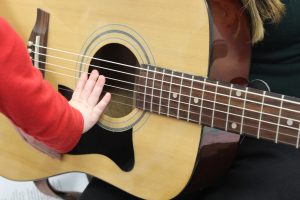
Chances are, if you have found this post you may have heard of music therapy. That is great! As music therapists we are very passionate about what we do and how it can be effective for people of all ages and abilities! If you would like to know more, please follow the link here to learn more. Today we are going to dive into a specific population or group of people and how music therapy is often effective for them! We are going to talk about Autism.
Autism also know as Autism Spectrum Disorder or ASD. A child or adult with Autism may have some delay to any varying degree of social skills, and speech skills in addition to varying sensory needs and sensitivities. Here is an example of how we would address the following,
Social Delay- This can vary from reflecting on the lyrics of a song to bring the client into a greater awareness of how others feel and express themselves to simply making and maintaining eye contact.
Speech Delay- Speech delays can range from entirely nonverbal to a stutter or using mostly abbreviated phrases. A music therapist can utilize rhythmic techniques to improve stuttering and song analysis to increase developmentally appropriate complex speech.
Sensory Needs- Like most aspects of this topic sensory needs also fall on a spectrum. What we often see is the ability to regulate sensory needs or the struggle to do so. For instance, if you are in a room where there is a sound or light which you find irritating or distracting… what do you do? Well, more than likely you may try to turn off the sound or light and if you can’t, then you may choose to leave. Many people with ASD not only are more sensitive than most people to sound, touch, light, etc. But when a sensory overload starts to happen they may not have the coping skills necessary to alleviate the problem. This is often where we see misplaced behaviors.
That being said, as music therapists we have a special perspective and influence when it comes to sensory needs. Music therapy utilizes varied techniques to cater to sensory needs while creating a great environment for increasing and improving speech, social skills, academic skills, life skills, and more. I often get asked “but isn’t music therapy loud?” No, not in many cases it truly depends of what is best for our client. As music therapy we practice an understanding of sensory needs practical for many different clients. We are aware that clients can be sensitive and are kind and gentle when finding volumes, instruments, and timbres of preference.
Are you interested in music therapy for you or someone you know?

Here are a few resources on Autism and music therapy,
Autism Speaks
American Music Therapy Association on Music Therapy and Autism
If you have any questions, contact us at info@musictherapyconnections.org.
-AH
by Alisabeth Hopper | Jan 12, 2017 | MTC
Hello All,
I love using these signs as an alternative to farm animals. If we’re all being honest, sometimes a little change from “Old MacDonald had a… Cow!” is very welcomed. It is also a fantastic opportunity to learn animals that a child, student, or client may now have been challenged with yet! Enjoy and watch for next week’s video!
-AH
by Alisabeth Hopper | Jan 11, 2017 | MTC
Hello all!
Here at MTC we have had a wonderful year! We are always so warmed by the positive thoughts and support we receive from the community and our amazing students! Im sure that many of you, like us here at the office are taking up a new years resolution. If your wondering how you can start a resolution that helps you grow musically, we have three tips below!
3 Musical resolutions you can actually keep!
- Practice more. Increase your practice time by five minutes or vow to practice every time you walk by the piano or guitar. Pick it up, play that chord you’ve been struggling with and put it back down. That simple resolution could increase your practice time by 30 minutes a week easily!
- Play more music you love. If you, like many students are using a book to learn, consider looking for songs you can play or sing that you really love! All of my students have a warm up song. This is our first song sung every week and not only does it help them to warm up but it gets them in great spirits because they get to sing or play a fun song that they enjoy.
- Specific goals like… learn a new chord every week, or learn a new song every week. The best way to keep these resolutions is by talking to your teacher and collaborating on how to have them hold you accountable.
The most important part of new years resolutions is to NEVER. GIVE. UP. If you forget to practice or get behind on your goal, know that you can ALWAYS pick it back up. We are all learning and growing. From all of us here at MTC have a happy 2017!
-AH
by Alisabeth Hopper | Aug 10, 2016 | Materials & Supplies, MTC, Reflections, Resources, Tips & Tricks
You may be wondering, what on earth is a Guitten? As the name suggests it is a small mitten (without the fingers of course) for the head of your guitar! It securely covers the tuning keys. Everybody sing it with me… hallelujah!
And yes, it really is as wonderful as it sounds!
I know we have all been there. You are strumming along and having a wonderful session when you strum your guitar and it happens. Your beautifully tuned 6-string is now 4 keys way to low with a string dangling from the fretboard and you realize your guitar has been compromised. More than likely one of your clients decided to curiously turn and twist those tempting tuning keys on your guitar. At this point retuning your guitar may be untimely, and your only option may be to put it away.
Let me be honest here, I heard about the Guitten from their table at a music therapy conference. I liked the idea when I saw them and nabbed one for myself. But in all honesty I would consider this a must have for all MT’s. It is a wonderful tool and they come in all kinds of colors and designs.
Want to know more? Check out their website here.
by Sammy | Aug 5, 2016 | Intern's Corner, MTC
Hello everyone! My name is Sammy Springer and I am the new intern at Music Therapy Connections. As everyone knows, Alisabeth was the previous intern and is now currently a music therapist at Music Therapy Connections! I will be carrying out her tradition of writing blogs for the Intern’s Corner for the next six months. That being said, I thought I would share some information about me this week so you all could get to know me a little better.
I grew up in Middleton/Madison, Wisconsin and went to college to study music therapy at Western Michigan University in Kalamazoo, MI. My primary instrument is the flute and I have been playing since I was eight years old. However, I also love playing the guitar and the piano! Since my junior year of high school I knew music therapy was the right career path for me; it seems unbelievable that I just finished my first week of my internship, but nonetheless, here I am fulfilling my dreams!
My first week as an intern was a little overwhelming, but overall, exciting. I am so excited and ready to learn everything that I can during the next six months! During this week, I mainly observed sessions where I was able to learn a lot about songwriting, assessments, self-care, and different therapeutic processes.
Here are just some of the things that I learned this week that might be useful to students and other new interns:
- Take a journal with you everywhere.
My internship directors recommended this to me this week and I found it to be extremely helpful. Just this week I filled pages with observation notes, lyric ideas, and lists of everything that I either needed to do or remember. Also, journaling or even taking notes during sessions throughout the day is a wonderful way to go back and reflect at the end of the day. It’s an important part of the learning process to reflect on everything!
- Writing original songs is not that scary!
Writing your own songs is important because you can write a song that can be tailored to each individual and their specific goals/objectives. Writing original songs and becoming comfortable sharing them is a goal of mine. It may seem taunting at first, but it really isn’t that bad! I encourage everyone, especially students and new interns, to try writing their own songs and sharing them. I wrote one this week and had to share it with my supervisors as well as the other music therapists, and I got through it just fine.
I am not sure how many times I have heard this throughout my lifetime, but it is just starting to click for me. Going to bed at a decent time, eating healthy, and taking time out for ourselves each day is extremely important. This week I started going to bed early every night and noticed a huge increase in my energy level. Although, I am not very good at practicing self-care right now, but it is something that I will concentrate on practicing for the rest of my life. If we don’t take care of ourselves, there is no way that we can help other people. I am excited to learn more self-care techniques and start practicing them!
Thanks for following me on my journey!
*Sammy Springer
by Katey Kratz | Jul 28, 2016 | MTC, Resources, Self Care
I cannot believe we are almost in August that we have a new intern starting on Tuesday!! My oh my, how time does fly. Both Rachel and I have had so much going on the past few months, on top of everything exciting happening at MTC, that we have felt a serious need to get back in touch with our mantra for this year: simplify, streamline, self-care.
We developed our mantra in late December of last year and have been actively working toward all three aspects. We’ve talked a lot about this mantra and ways we’ve been working toward those goals in several blog posts I’ve linked to below. Simplifying and Streamlining have been huge and exciting areas of focus and things we talk about almost daily as we continue to grow our team and expand our services. But with all of the hustle to achieve those goals, self-care has sometimes taken a back seat.
We value our team members, student, clients, and families and want to be our best for them every day. We also value our interns and understand that internship is a very stressful time and a huge transitional period from being a student to a practicing professional.
We want to lead by example. Putting focus on and implementing our own self-care routines helps us to be our best selves in all we do. It allows us to be more present, provide a positive example for those around us, stay balanced in work and in life, and simply be accountable. Self-care is a continual journey and something we really want to practice.
Rachel and I spent time on Tuesday talking about the importance of self-care and sharing some of the ways we practice self-care in our live Facebook video.
As we continue this self-care journey and as Sammy begins her internship, we’d love to hear some of the ways your practice self-care and what helps you to find balance in your daily life. Looking for other ideas to jump start your self-care journey? Check out the other blog posts we’ve written on this topic:
https://musictherapyconnections.org /2016/01/three-words-for-2016.html
https://musictherapyconnections.org /2016/01/simplify-streamline-self-care.html
http://lead.musictherapyconnections.org /interns-corner-week-23/
http://www.onagoodnote.net/2016-simplify-streamline-selfcare/
http://www.onagoodnote.net/2016-simplify-streamline-self-care-part-2/
http://www.onagoodnote.net/2016-simplify-streamline-self-care-part-3/
http://www.onagoodnote.net/self-care-check-in/
http://www.onagoodnote.net/its-tuesday-and-im-exhausted/