This is the question we get asked, hands down, without a doubt, more than anything else. And the answer is…. ABSOLUTELY!!
Our studio has taught lessons for people ages 5 – 95 and our therapy clients range in age from 0 -102!!
We know, based on our social media and our website, that it might look like we work pretty exclusively with kids; but honestly, that’s just because fewer adults want their picture taken.
The truth of it is, some of our favorite students (and clients) are adults. (Shhh 🤫 don’t tell the little ones!)
Not only is it nice to be able to chat with another grown up and converse at the same level during lessons, our adult students also really want to be there.
There’s no parent or caregiver repeating “they have to practice” or telling them to participate in the recitalOur adult students are self-motivated, making the teaching process even more fun for all of us!
We also love getting to dive into some to the deeper subjects (like theory) and learn new music our younger students might not be listening to.
Of course, on occasion, we have the surprise request for “Smoke on the Water”, the Eagles, or Kansas, from one of our 7 year-olds, but typically the kids are requesting a lot of Disney, the newest Netflix kids movie, and Taylor Swift (no shame to those choices, because there are some JAMS).
Don’t forget, lessons are incredibly beneficial for adults as well!On top of all of the fun and joy that comes with playing an instrument, there’s also the legitimate health and wellness benefits that come with working on a musical skill. Think: memory, fine motor skills, brain exercises, stress management, etc. Learning music is one of the best things for you!
So if you’ve been holding out, thinking “this is just for kids”, kick those thoughts aside. Now is YOUR time.
We’d love to see you in the studio.AND if you think you’ll be “the only grown up”, we’ll prove you wrong at one of our adult open mic or mini recital nights, where just our adult students spend a night making music together!
See you in the studio soon!
-Katey
Join Our Music Community
Ready to start your musical journey? Whether you’re picking up an instrument for the first time or revisiting an old passion, our adult music lessons are designed for you. Contact us today to learn more and begin your adventure!
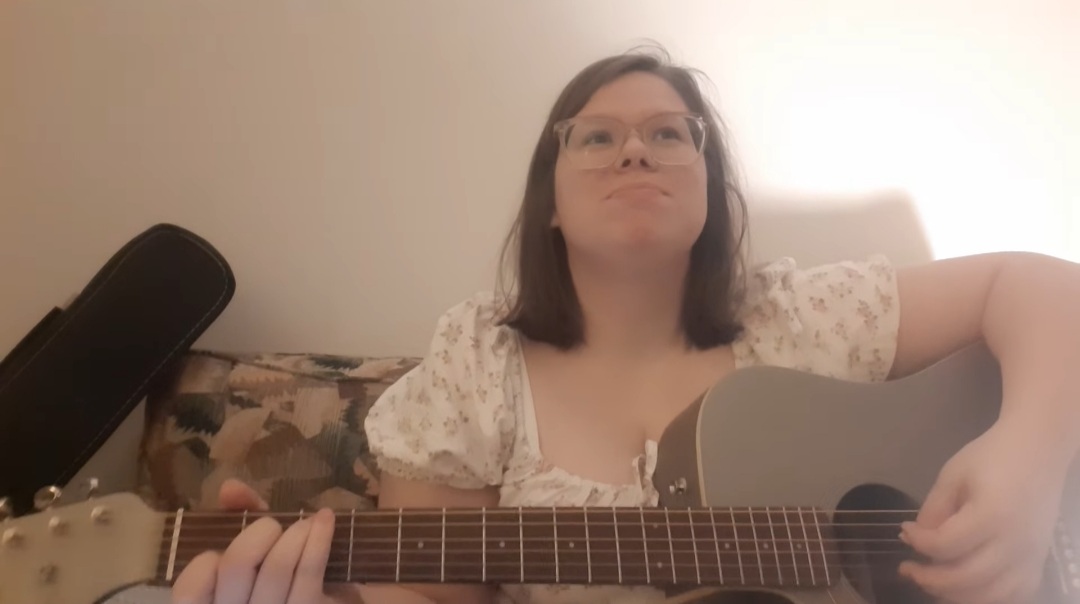
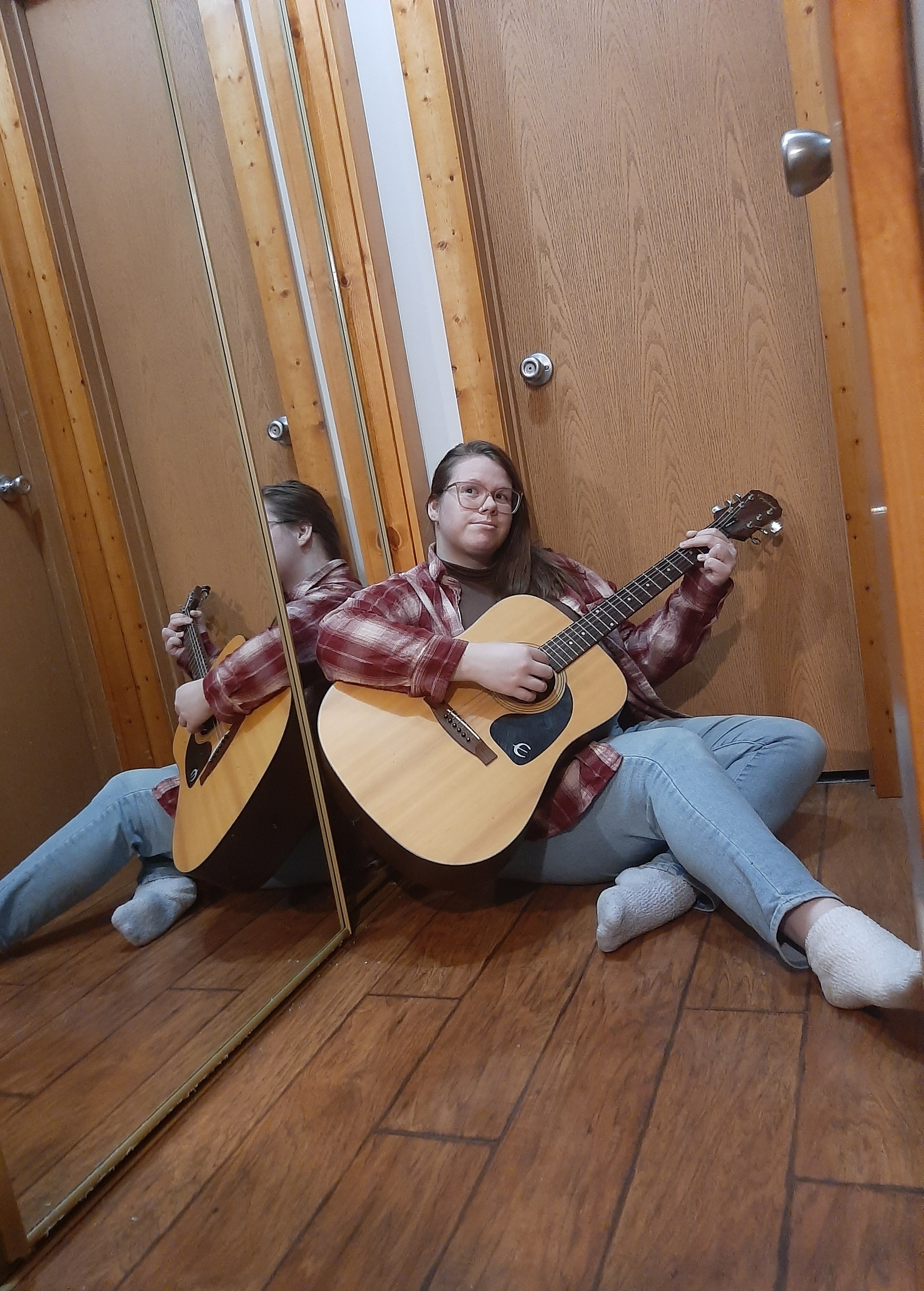
A screenshot from an internship application video I took last summer, having no idea what the next year held in store. I love how happy and at peace I look while playing and hoping for an internship site to say yes.
As I am writing my last post as an intern, it’s weird to think that a year ago I was terrified that I would never find an internship. I was worried that I wouldn’t become an MT-BC and that all my years of school and hard work were for nothing. At this point in time last year, I had been finished with my coursework portion of undergrad for four months and sending out internship applications for over twice as long. It’s not an exaggeration to say I was starting to feel doomed. Mindset is everything though.
I told myself that everyone moves at different rates and that everyone’s journey is different. This became a mantra I repeated to myself even when I didn’t quite believe it.
The pressure of the imagined timeline
Having a different timeline is hard though. My coursework took me five and a half years. I struggled with my health and couldn’t do the 20 credit hours a semester that my peers were doing. I watched them finish their coursework in four years, and although I knew my circumstances were different than theirs, it made me angry and embarrassed that I couldn’t adhere to the same timeline I felt like everyone else was on.
Even after finishing my coursework, it felt like I just couldn’t live by the same timeline as everyone else. I thought I had secured an internship only for it to fall through. Everything fell through and before I knew it I was back home looking for any job so I could afford rent. I was so sure I wanted to go out of state and that I wouldn’t find an internship in Illinois. I let myself believe that I was the only student to struggle so hard to find an internship. At some point I decided that I was going to get an internship even if I had to go to the other side of the country and it took me a million years. I put all this time and effort into it and it was still my dream so it was going to happen.
Timing
It was good that I was home though. We almost lost my grandpa twice. If I had been out of state I would not have made it back home in time. Sometimes things just fall into place. For me this internship fell into place. I had reached out before while I was still doing coursework and they weren’t taking interns. As sort of a hail-mary I reached out near the end of last summer to see if they were taking any interns and they responded that they were considering it. Obviously it worked out. I thought I would end up here at MTC when I was in undergrad and wildly enough I did when both MTC and myself were in the right time and place.
It has really made me think about timing and opportunities falling into place. So many times in my life I have wanted something so bad and not gotten it only for the right thing to come along later. Coming back around to mindset, I like to look for the positives in the situation and while I don’t believe everything happens for a reason, I think some things do. I think though it was upsetting that I didn’t get to stick to the timeline I thought I was supposed to be living, it happened the way it needed to. Had I forced myself to do 20 credits a semester I would have never graduated or have taken the class where I met one of the most important people in my life. Had I gotten that first internship, I would have been too far away to have come home when I was needed.
While thinking bout this a while back during my internship I wrote some ideas of lyrics to a song that I never finished:
“I thought it was the ticking of a clock, But it was really everything clicking into place. Felt like I was running, running, running. Trying to catch up. Trying to prove myself. Trying to be where I thought I was supposed to be. Every step was a choice Was a battle I fought. I’ve worked so hard. I’ve earned what I’ve got.
No one’s gonna ask how long the journey took. How many losses I withstood. They’ll just see me. That I’m where I’m meant to be. Surrounded by love. That I love me. And I love who I’m going to be.”
Thoughts
None of this has been easy. I have worked my hind quarters off for everything and now I am looking at my last week of internship. If you take anything away, I hope that it is the fact that you are not behind and to not give up. Everyone is on their own time and journey. The clock is not running out.
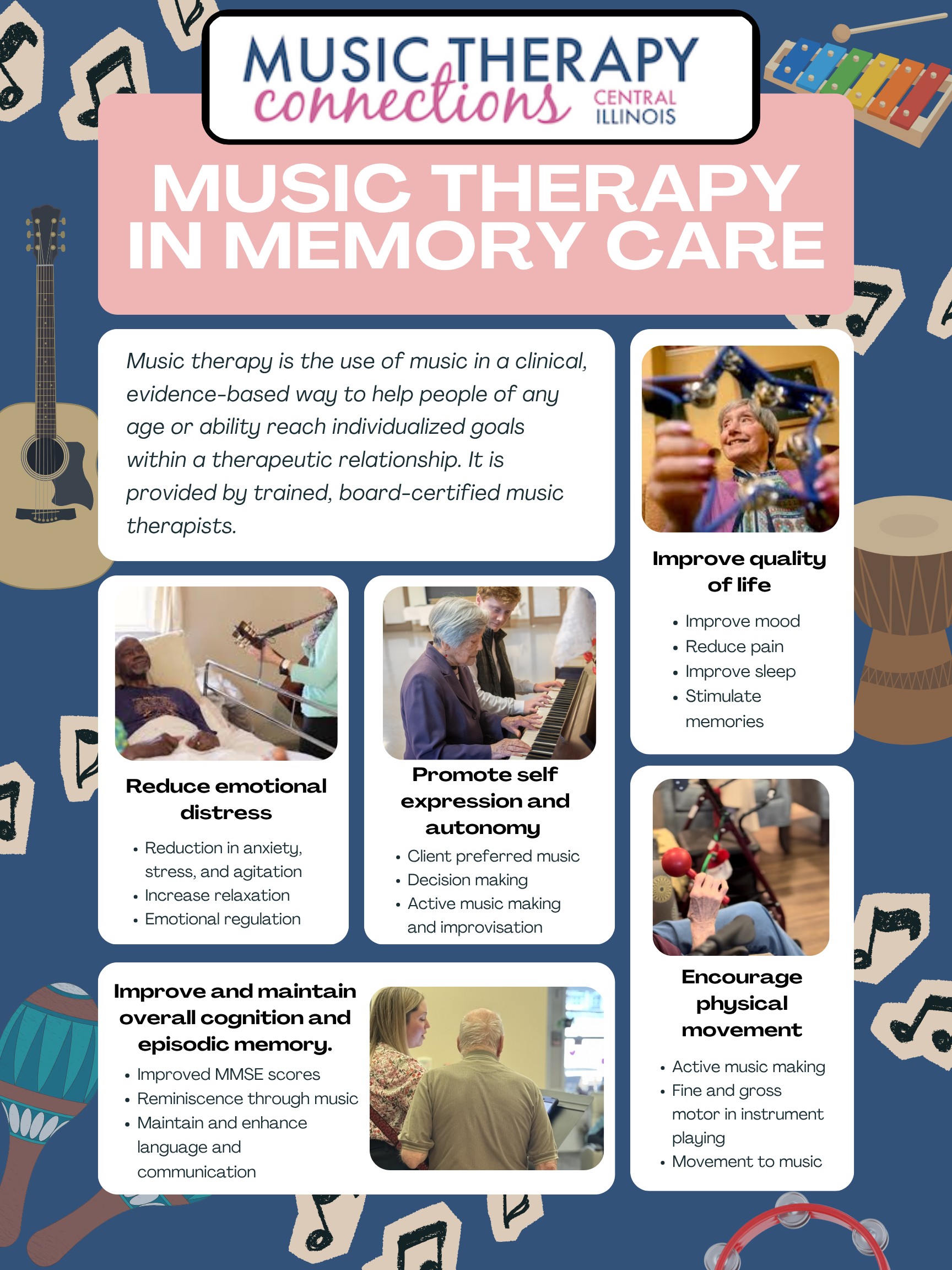
My super cool, eye-catching marketing material that I made after embracing my creativity.
There are so many things I knew I would do in internship, but to get a contract was not one of those things. Whether I foresaw it or not, here I am in the midst of trying to do that very thing.
Final project
As part of your internship you have to complete a final project. You talk with your supervisors and decide what it will be. I in a moment of “go big or go home'” decided that I wanted to try and secure a contract with a memory care or hospice facility. In my head it sounded easy. You just do it and “bada bing, bada boom” you’ve got a new contract you’re in charge of. I was not thinking of any of the middle steps in that moment.
Breaking it down
Once I was getting closer to having to do it, it started feeling like a herculean task. What part of the elephant do I take a bite of first? That is when I met with Katey, one of my supervisors and the business owner. We made the giant task into smaller bite-sized tasks. We started with the endpoint of what I wanted and worked back from there. I quickly realized that I wildly underestimated how many calls and emails I would have to make and just how much socialization I would have to do.
Acquire a contract with hospice or memory care for 1:1 sessions.
Meeting with admin
FAQ
Program Plan
How much is going to cost
How is it being paid for
What materials are being
Expectations
Documentation
Explaining benefits
Data
Outreach to hospice/memory care company
Email exchange
Written email part
Who is this person
Pdf with information (marketing assignment)
Initial eye catching – sell yourself
Data
Memory care/Hospice
I chose this as my final because I really hope to one day work with older adults in both memory care and hospice. A majority of the contracts at MTC serve children. I love working with children but older adults has always been my jam. Not to mention the idea of bringing in a new contract and helping MTC expand was a pretty cool idea.
While in college, I worked as a student music therapist at a nursing home. It was so special to me. I loved every minute of it. I loved it even when I was in full PPE because of COVID. The same goes for when I go the opportunity to do my practicum in hospice. I fell deeper in love with music therapy in those places.
Following the plans
Starting is the hardest part. Having the first thing I needed to do be create marketing materials made starting even harder. As I mentioned in a previous post, I did not consider myself to be creative. Even now, my first reaction is to say that I am not creative. I draw stick figures. After a lost attempt on Canva and a small breakdown, I accepted some help and stopped overthinking it. I even began to have fun with it. I went so far as to even make a second flier. It also helped lead into the next part.
First contact
At this point in time I had already done research on different memory care and hospice facilities in the area and made a list of my top choices. I then had to draft an email. Lucky for me, I had a really cool, eye catching flier to do the talking for me.
In my planning, I had not taken into account the fact that I needed the email addresses of the activity coordinators which was not included on any of the websites. That’s where all the calls came into play. I had to call each facility and ask for the contact info. Most of the time, I was forwarded to the activities director who I then had to ask for their contact info since they didn’t have much time to talk. I definitely felt awkward, but I put on my big girl pants and pretended to be the most confident businesswoman version of myself.
Meeting preparations
After writing and sending the emails, I had to wait and after days had passed I sent follow-up emails. While waiting, I had to prepare for any meetings I would hopefully have. I met with Katey again and we discussed potential questions that may come up. She threw all sorts of questions at me so that I wouldn’t be caught off guard when it came to the real thing. I felt so prepared.
The day came. I got responses and meetings and calls were set up. I now find myself on the other side of these meetings waiting for any news of a potential contract. Even if nothing comes from this, I have done so many things outside of my comfort zone. I have done it once so it won’t be so scary to try again in the future or to just to keep trying.
To wrap up my final project, I will put all my correspondences with facilities together along with a sample session plan. I can’t believe that is what I have left of my final. Something so big and scary is so attainable and close now. As I wrap up, I can’t help but to think of everything I have accomplished in my time as an intern.
A picture taken at the beginning of my journey here at Music Therapy connections. I have learned so very much.
In my last blog post I reflected on growing. This week I want to reflect on learning and lessons that I have gained during internship. While creating this week’s blog, I struggled with figuring out what to write about and found myself not feeling completely done with what I started in my blog post two weeks ago. Going into my last month of internship it has been feeling hard for various reasons, so I wanted to focus on what I have learned and achieved in my time so far.
The importance of mindset
My entire life I have been a worrier. If given a situation, my brain would find all the ways it could go wrong before thinking of one positive thing that may happen. Even after finding multiple positive things that could happen, I focused on the bad. I was conditioned by life to assume the bad outcome. Life is different now. My circumstances are different. Why am I still choosing the mindset that every outcome will be bad?
We create and invite in what we think. You might be thinking ‘GraceAnne, you are sounding a little bit like a self-help book’. My only reply would be ‘Yes, I have been reading one and this resonated with me’. If I enter every situation anticipating the bad, I will only ever see the bad. I liken it to when you come across a word you were unfamiliar with and now you see it everywhere. It’s not that every book and sign added that word overnight, but that you are now conscious of that word.
It is my choice whether or not to focus on the bad even after I have come up with all the positive outcomes. I know that one does not just wake up and stop thinking negatively. It takes time and the conscious decision to do so. This week, I have been asking myself does worrying about this help me or change the outcome or does it just use energy.
Today, I talked with my coworker Jess and she gave me some advice that she used in her last month of internship. Create a sticky note wall of all the positives, all the wins from the day. Any win, no matter how small. Choose to focus on and acknowledge the positives.
The art of doing things outside of your comfort zone
You may not be surprised to learn that I don’t like doing things outside of my comfort zone. However never leaving your comfort zone is not conducive to growth and learning.
Without leaving my comfort zone, I would not have found out that I love teaching lessons. I wouldn’t try anything new with my clients. I wouldn’t have gotten this internship.
This week, I worked on going outside of my comfort zone in a different way than usual. Making calls was not in my comfort zone. Can’t it be a text or an email? Do I really have to call and talk to another human being? Oh, the horror. If given the choice to make a phone call myself or give someone my entire bank account to do it for me, it would be a tossup . Being that I can’t pay someone to make phone calls for me and that even if I could, I need my money to be alive, I made my own phone calls this week. It turns out that a part of my final project requires me to make phone calls. Having no other choice I did it and I survived.
Communication and asking for help
A big point of growth and learning has come in the form of me working to better communicate. Is it something that I am still working on? Absolutely, but I have also come a long way. In my worrying and perfectionism, I thought I had to do everything alone. I thought I had to fix the problem before anyone noticed and just hope that they didn’t bring it up. With previous experiences and my own conditioning to assume the worst, I curled up with my head as far down in the sand instead of communicating.
I am definitely not a master communicator by ay mean, nor have I gotten it all figured out, but I continue to work to do better. Communicating make me a better professional, clinician, and coworker.
What matters at the end of the day
I love myself, quirks and all. Being myself has made me a happier person and a better clinician. I trust that I am good at what I do and that I have or am gaining the skills I need to do so. As my internship goes into the last month and it feels like we have entered crunch time and are diving into the details, I am imploring myself to remember what matters most. I enjoy what I do. I am doing my best for my clients. I like who I am.
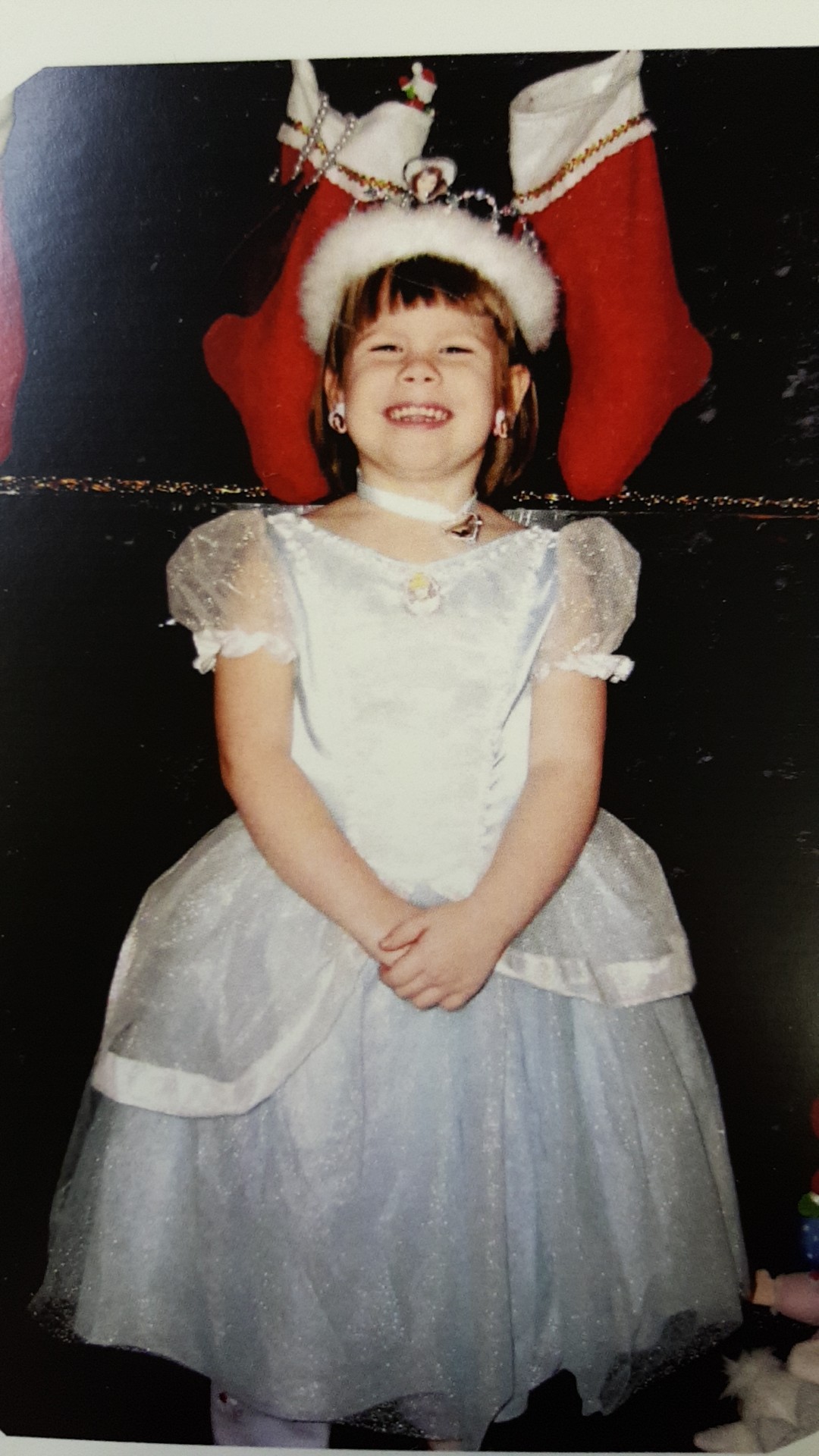
Photo evidence that we all grow. We grow taller. We grow wiser. We grow older. We grow everyday.
Reflecting on my time thus far at MTC, I would say that the word that best describes my internship has been growth. You might be thinking, ‘It’s an internship; I hope you are growing.’ Everybody grows during their internship. Going into this internship, I knew that I would grow. Growing is uncomfortable. Trying new things is scary. Taking any step outside of my safe little bubble feels like being asked to go skydiving. Growing has been frustrating and difficult, but also rewarding and hard-earned, too.
Lately, the word recontextualizing has been popping up a lot in my life. What is recontextualizing? What does it mean to me? And what does it have to do with growth?
Definition of recontextualizing
If you ask Google, to recontextualize is to consider the matter from a new or different context. To me, recontextualizing can be a lot of things. It can be choosing to find the positive or something I can learn from in the situation. It can be not overthinking or looking at something with such a black and white perspective. Most simple of all, it can be taking a step back from the situation in order to see it objectively.
Recontextualizing in my life
Last week I was having a rough week. I just could not catch a break. The funny thing is, now a week later, I can’t even remember everything that the week was so hard. All I could think was that it was an awful week and that I felt cursed. I felt like I had somehow offended the universe and offset the balance of things. Do I believe that I was actually cursed or that I was manifesting for bad things to happen? No. I do believe that our brains are great at finding patterns, whether they exist or not. I was thinking negatively, so the negative instances felt bigger.
My computer shut down, and I lost all my progress on my marketing assignment. Cursed? Maybe. Or maybe it was a chance to grow.
Maybe I just needed to view it from a non-cursed feeling viewpoint. My supervisors told me that maybe this was a chance to start over and approach the project with less overthinking involved. My first thought to that was “that’s baloney”. That thought was quickly followed by “they are asking me to think less about a creative project. I am not creative”.
Creativity
That is the sentence. I am not creative. In fact, I feel like a very uncreative person. Creative and artsy to me is coloring a picture that had the lines and image added far before it came to me. That is concrete. Research is concrete. Making an eye-catching marketing material from scratch so that I can hopefully set up a new contract for my final is pretty far from concrete. I have aphantasia. I cannot visualize. I have no idea what I want or what I think it should look like. Just let me stick to my research and data and spiral… spiral…. spiral.
What does it mean to be creative? Does creativity only pertain to art, and in this case, graphic design? Aren’t I creative in other ways? Haven’t I written my own music? Improvised within a session? Made music from nothing every day? These thoughts had no choice but to permeate in my brain as my supervisor stared me down and made me repeat that I was creative. But she and my brain (later) were right. Recontextualizing my definition of creativity changed the answer to whether I found myself to be creative or not. I may not be painting any masterpieces soon, but dang, did I make a good Canva marketing graphic.
Difficult conversations
I have to recontextualize after difficult conversations. As an intern, there are times when my supervisors and I have to have harder conversations, where constructive criticism is given. It is hard not to take everything personally, to not feel that every criticism is a personal failing on my part. You may think that sounds dramatic, but it is true for me. I have been working really hard to take a step back and to look at the situation objectively. To listen and go over what was actually said and not just what my feelings and brain heard.
New experiences
I didn’t realize how much I recontextualize in my life outside of my internship recently. I struggle to try new things, especially foods. When at a restaurant, no one is surprised when I order my safe foods. I’m lucky that most restaurants I go to, I can order a salad or chicken or a burger, but when that’s not an option, I get super anxious. Two weeks ago, I was almost in tears when my boyfriend said his family made summer rolls. I couldn’t just leave after they graciously made food. I started to spiral. I’d never had Vietnamese food before. What if I didn’t like it? What if it were a ‘bad’ texture? I wouldn’t have anything else to be able to eat, and then my blood sugar would get low and spiral… spiral….. spiral.
With the help of my boyfriend, we recontextualized the summer rolls. Summer rolls are made out of rice paper. Well, I have had rice before. I have had rice noodles before. I’ve had shrimp before. I’ve had carrots and spinach before. Something that was so scary wasn’t so scary anymore.
Growing
Recontextualizing has been a tool to aid in my growth this last month. Growing is more than just trying to find the positives each day. I don’t believe in toxic positivity or that we all have to be positive all of the time. Growing is showing up and trying. It has only been six months, and I have so much more growing to do, but it’s good to acknowledge all the growth I have made.
Growing is hard. Growing is not linear. Growing takes time.
GraceAnne
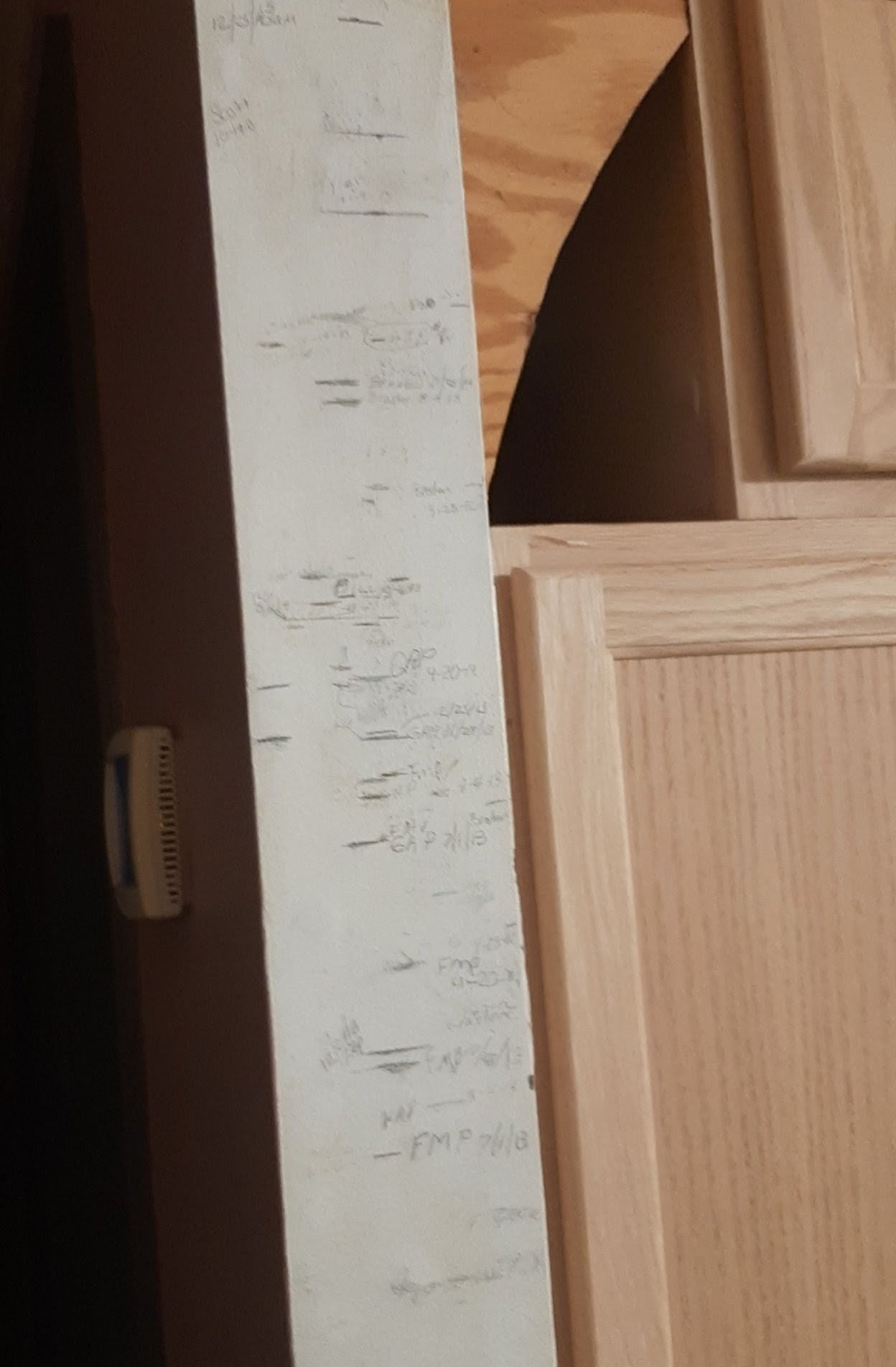
The doorway where my grandparents kept track of my siblings’, cousins’, and my height over the years of my youth.
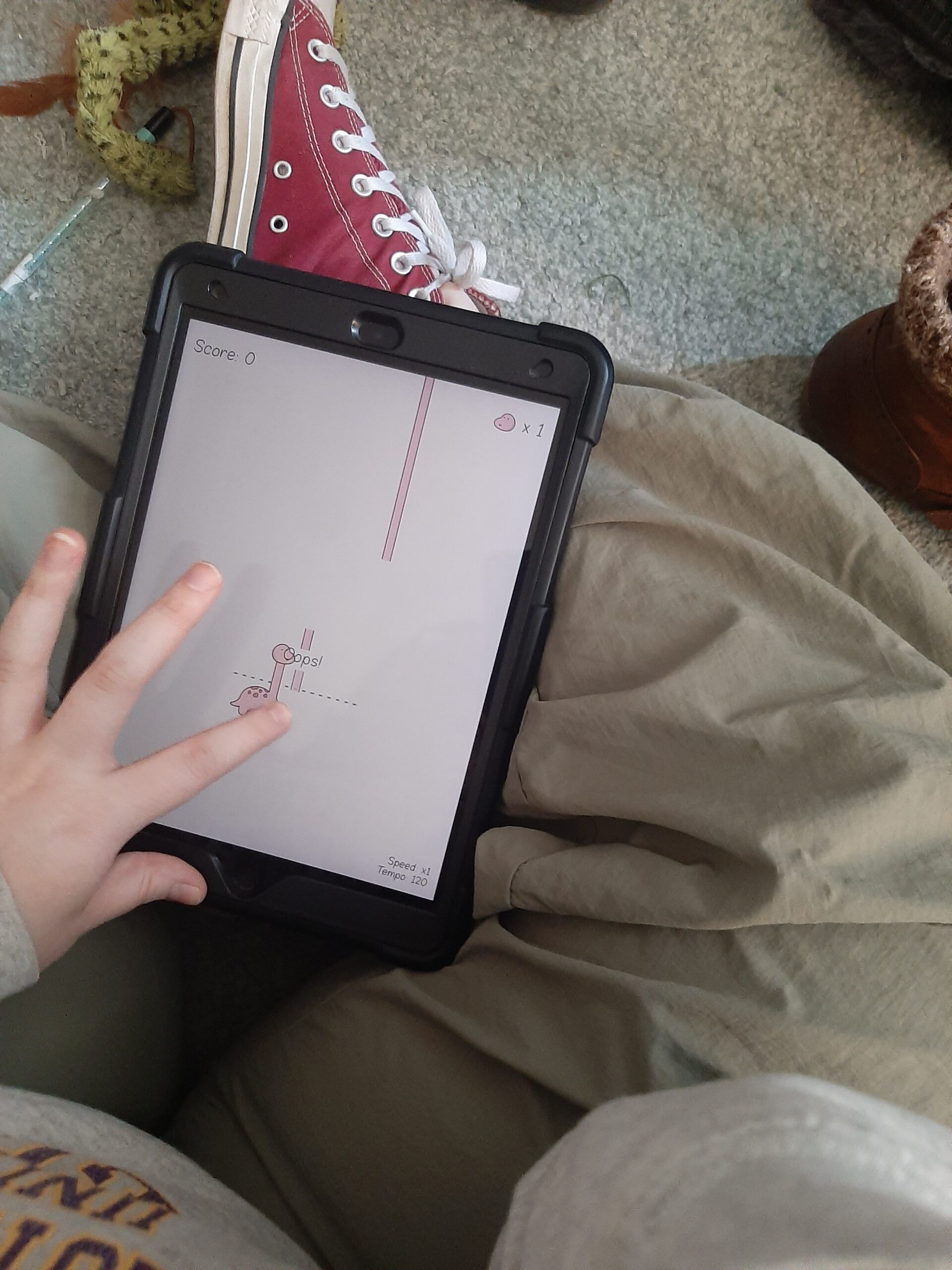
A sneak peak of me playing Like A Dino! I have been playing it all week and telling anyone who asks that it’s homework.
This weeks assignment was to find five iPad apps that are appropriate for clinical practice. I wanted to share what I found with you. Maybe the five I found seem like a stretch to you. Maybe you never thought of using that app that way or even at all. It was a fun assignment. I had no idea what apps were even out there as I scrolled through the app store. I went down many rabbit holes and had to start off with what apps do I already use with clients.
So why write about this assignment? Getting out of school, I never thought about using my iPad in sessions outside of using it for chord charts. In my internship, using games like SoundForest or writing a song with a client on GarageBand was super foreign to me. Maybe it is foreign to you too. Maybe my exploration can be of use to other interns and professionals.
Without further ado, here are the five apps I found.
No 1. GarageBand
Summary
GarageBand is an app for making and recording music. It has so many options that it is almost overwhelming. It offers a wide array of instruments to choose from, as well as the ability to directly record piano, guitar, and bass and plug in music and instruments from external apps. Melodic instruments have the options of chords or notes. You don’t need to know how to play in order to play the instrument on GarageBand. In the settings you can change the chords. Moving up and down the chord changes the voicing and a visual auto play knob adds more complexity between chord changes. Drums has a drum machine, acoustic drums, and a beat sequencer. All these instruments and voice can be recorded onto tracks that can be layered and played together. Once recorded, you can balance tracks and add effects.
Clinical use
GarageBand can be used with clients to write music. You don’t have to know any chords or actually play those instruments in order to play them on GarageBand. This makes songwriting easier for clients. Clients can use the chord function to create a chord progression. These same chords/notes can be used across instruments to add layers to the song. Clients can also use the note function to add complexity and a melody. On the note function, you can change the scales from chromatic to pentatonic or whatever is best for your client. Clients can also create their own beat, whether for their song or just to enjoy or dance to. Writing music is great for areas such as self expression, autonomy, and emotional processing. GarageBand gives them the ability to truly lead the songwriting.
Drawbacks
While I love this app, there are so many options from instruments, sounds, chords, scales, and beyond. It is easy to get decision fatigue and feel overwhelmed. Even spending days tinkering around, I have not tried even half of the options and am still feel like I am getting the hang of the basic functions. It is definitely a step by step process that requires patience.
No. 2 The Lyrics App
Summary
Staying on the topic of songwriting, The Lyrics App is another tool that can be used. The app allows you to write down lyrics and record a melody in the same place without having to flip between pages. For each line of lyrics you write, you can record a melody. A feature of the app is that it allows you to click on the word you have written and choose rhyme or thesaurus. When choosing rhyme, a list appears of words that rhyme with the one you have highlighted. When choosing thesaurus, a list appears of synonyms for that word. A play button at the bottom of the screen plays all the recordings in the order you have them and the clipboard icon copies all your lyrics. Lines/sections of lyrics can be moved around without having to rewrite or rerecord.
Clinical use
This app made me think specifically of a client I saw during practicum at WIU. She loved to write songs but never remembered the melodies she created and lacked a piano or the musical knowledge to notate the melody. When we did spontaneous songwriting in that group, I did not have a piano to notate the melody the group came up with. This could be used for songwriting with a client. In a setting where self-expression and emotional processing is the main goal, songwriting can be very helpful. Clients can process and express themselves through the lyrics they write. This app lets you record so you can hear how different melodies sound before choosing one to notate. It also can help clients by giving rhyming words and synonyms to choose from. I could see this being used in a mental health setting.
Drawbacks
It really delivers on what it says it will do, but it took poking around and maneuvering on my end to find and use the rhyme and thesaurus options. I also wish the app had a place where you could notate the melody after recording it or at least include a piano function. Besides those gripes, it is very straight forward. All the creativity in this app is in the lyrics you write.
No 3. Launchpad
Summary
Launchpad creates a backing loop. It has more than just drum sounds. Opening the app, you choose a sound pack/mood. Each sound pack has eight columns with six options each to create your music. The first column is different drum loops. The second column is percussion loops. The third is bass. Columns four through six are different melodic loops. Column seven and eight are different sound effects. You can only choose one loop in a column at a time. The loops are different in each sound pack. Within the app you can change the tempo and key and record when you like what you have. You can also pay for and download individual loops in order to create your own sound pack.
Clinical use
Similar to options on GarageBand, clients can make music with the touch of a button. This app requires less musical knowledge than GarageBand and creates music more realistic in EDM, rap, hip-hop, and lo-fi. Once recorded it can be plugged into GarageBand where you can add other instruments and tracks. Because it has buttons in a column it could be more accessible to clients than GarageBand. I could see using this app with one of the high schools I see to create a beat to add to a song or just to stand alone. I previously used the beat maker on GarageBand but they said it didn’t have enough of a hip-hop sound.
Drawbacks
My biggest issue with this app is that the music can only be in a minor key. Maybe major keys aren’t as common in the genres of music it caters to, but I would love to have the option. I also wish you didn’t have to pay for as much as you do on this app. While a lot is free, a lot of options are not.
No 4. SoundForest
Summary
Similar to a beat maker, SoundForest has four beats per page subdivided into sixteenth notes. Rather than normal drum sounds, it has different nature and animal characters, each with their own unique sound that you can place on the screen. The lower you place it in the column, the lower the pitch. You can add multiple to the same column. The characters and sounds change depending on the environment. Using the bar at the top you can speed up or slow down your song. While you can’t change the rhythmic value of any of the sounds, some are longer than others.
Clinical use
In a group setting this app can be used to work on waiting one’s turn, respecting the choices of others, as well as emotional regulation. It can also be used to work on musical skills such as subdivision and rhythmic notation. This app allows clients to create music without getting too technical and still being fun and gamified. The characters also correlate with the environment which opens up to some academic skills of where mountains or giraffes are found, while still making music. It can be adapted in many ways. In HTDA, I used this app as a fun creative way to work on rhythmic notation and turn taking.
Drawbacks
My only gripe is that I can’t change the note value. I would love to be able to make sounds last for a half note or a whole note instead of trying to imagine that it is. I also wish that the columns had lines to show the breakdown of the four pulses per column. Every time I add a sound, I hope I eyeballed it well enough for it to land in the beat I want it to.
No 5. Like A Dino!
Summary
A musical game that requires you to move the dinosaur across the screen to catch blocks of his neck to make him taller. The falling blocks are tied to the rhythm and usually the pitch of the background music. Each block is a note of the music. Long notes are long blocks. Short notes are short blocks. Lower pitches are farther to the left and higher pitches are to the right. As you progress the music gets faster. It starts at 1x speed and then gains .1x speed each round. As you make it through the rounds you unlock new music. You have three tries/mistakes before the round starts over. When mistakes happen positive affirmations pop up on the screen.
Clinical use
My first thought when looking at this app from a clinical perspective was that it could be used to target fine motor skills and motor planning. To move the dinosaur, you have to use one finger and drag the dinosaur back and forth across the screen. As levels get faster the harder it is. To up the difficulty, clients could use different fingers. Being in a game format and on the iPad could serve as a motivator for kids. I think this app could also help with understanding musical skills. Like a piano, the lower notes are on the left and the higher on the right. There is also the visual of long and short blocks to go with the auditory of long and short notes.
Drawbacks
I wish you could add your own music. This would be a great way to include client preferred music. I also wish you could choose what speed to play it on. As you progress through the level, it gets faster. It would be cool if you could choose to stay on 1x speed or 1.3x speed.
Honorable mention- Easy Play Piano
An app made by a music therapist. It consists of a diatonic scale set up as color-coded bars that is easy and accessible for everyone. In the settings you can change the key. Cool app for melodic improvisation with any age without having to know pitches or transport anything and easy for anyone to use and make a sound with. They also have an app that is just the C pentatonic scale set up the same way.
Drawback
I wish I could go back and forth between the diatonic and pentatonic scale on the same app as well as change the sound beyond the piano.
Wrap up
I would love to know if you would use these apps and how you would use them. Would you use them similarly or in a way I couldn’t even imagine? I would love to know. What apps do you use and recommend in your clinical practice?
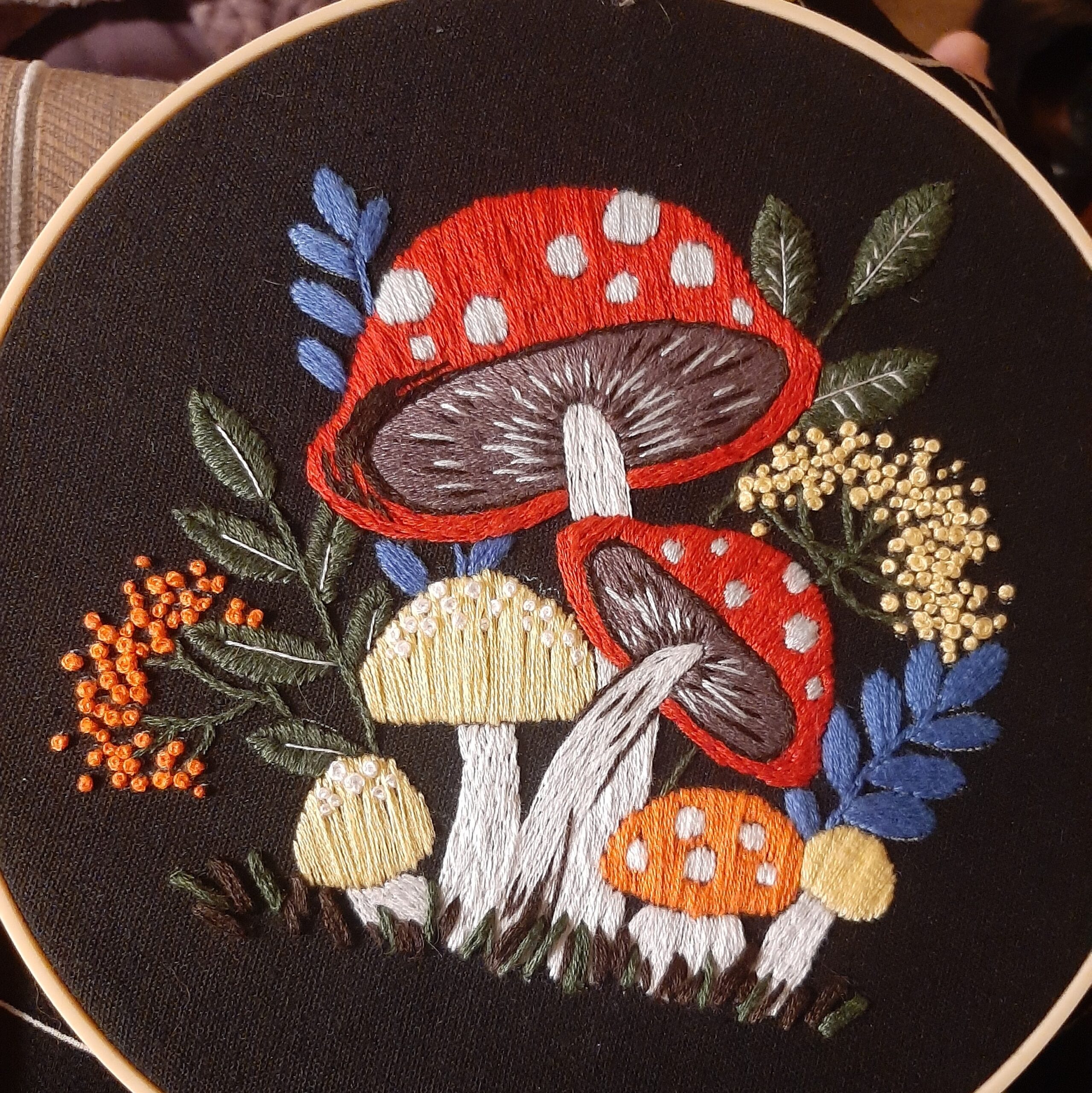
My recent self-care activity has been getting into embroidery. This is my first project that I have completed.
With yesterday being valentine’s day, the subject of love is a common theme. There are so many types of love in our lives. The focus of my blog today is self love. How does self love or self care, a better term for this post, intersect with music therapy, internship, or overall life? It intersects through subjects I’ve been meaning to research and write about: compassion fatigue and burnout. Instead of committing to writing it, I have opted to write about easier subjects. While I love reading research, it’s difficult to find motivation when there are so few articles on the topic. I did find a couple of theses. It’s also hard to write about something you struggle with and for me that’s both burnout and self care. So in the interest of working on self growth and learning more about self care, I decided it was time to do this blog and read those theses.
Before diving into self care, I think it is important to first define burnout, compassion fatigue, and self care and their components.
Definitions
Burnout
At its most basic definition, burnout is mental/emotional exhaustion. Burnout is made up of “three distinct categories of symptoms: depersonalization, emotional exhaustion, and a lack of personal accomplishment” (Maslach & Jackson 1986). Depersonalization is explained as detachment from others, especially to the ones who receive care and services (Walker pg. 9).
In Neel’s study, subcategories such as “isolation” and “stressed relationships” paralleled depersonalization, “emotional instability” paralleled emotional exhaustion, and “lack of motivation, “procrastination”, and “decreased concentration” paralleled lack of personal accomplishment (Neel 2017). These subcategories helped me better understand but also reflect on how they may or may not show up in my life.
Compassion Fatigue
Compassion fatigue is a form of emotional burnout commonly seen in professions involved in the care of others.
Self care
The National Institute of Mental Health (NIH) defines self care as activities that help improve your life as well as your physical and mental health. Participating in self care helps manage stress, reduce illness, increase energy levels and help minimize effects of burnout.
Burnout in Music Therapy
The use of the word burnout in this setting and circumstances has been reserved for credentialed music therapists. Walker referenced data from Oppenheim’s (1987) article on factors that lead to occupational stress in music therapists. The highest reported causes of stress were “insufficient pay, lack of support and respect from administrators, and having to perform activities outside of the field” (Walker pg 11). These sources that lead to stress can also affect interns.
Besides stress, a “lack of self-awareness of needs, prolonged exposure to trauma, and lack of time or opportunities to focus personal development” can contribute to burnout and compassion fatigue (Oppenheim, 1987).
Compassion fatigue and burnout can lead to circumstances where clinicians end up leaving their profession. In a study by Cohen & Behrens referenced by Neel, “the average longevity of a music therapist is 13 to 14 years”(Cohen & Behrens, 2002)(Neel pg 12). This is not surprising when paired with data from Vega (2010) that found that music therapists are “more emotionally exhausted than the average mental health worker is” (p. 171).
So where does self-care come in?
As stated earlier, self-care can help minimize the effects of burnout, which in turn could hopefully help with the retention rate of music therapists. I have heard so many times that you can not pour from an empty cup. Self-care helps fill our cups.
My history with self-care
I have struggled with self-care. In my supervision last week, I talked about how it is hard to do things for myself. The last ten years of my life have been go, go, go. Give until there is nothing left to give. Did I give good results? Yes, most of the time, but it’s not sustainable. I found myself much like I find myself right now: exhausted. Exhausted, procrastinating, feeling guilty for staring at my assignment and not getting it done, but also feeling guilty if I stop and take a break or do something I enjoy. My team has changed my schedule around so I have time for my body to heal from surgery, to rest up, to allow me to partake in self-care, but here I am after my first week with this schedule struggling. As easy as it is to say to others, it is hard to tell myself that progress isn’t linear. Part of that progress for me is to work on my self-care
Ideas of self-care for myself
Starting off easy, I made a list from self-care activities I have taken part in before. I want there to be more facets to my being than working a lot and being tired.
Non work related hobbies
Reading
Embroidery
Baking
Going on walks
Dancing for fun
Making home cooked healthy meals
Staying better connected with my grandparents
Being more social
Taking the opportunity to try something new
Enjoying nature as it gets warmer
Therapy
References
Maslach, C., & Jackson, S. E. (1986). Maslach burnout inventory manual. Palo Alto: Consulting Psychologists Press.
Neel, Kristin Marie (2017). Self-Care For Students: A Pilot Study On Self-Care Education For The Preinternship Music Therapy Student. Appalachian State University. Thesis. https://doi.org/10.71889/5fylantbak.29862563.v1
This week’s assignment was to create two lists of instruments, props, and materials I would buy if I was given $500. The first list consisted of items that I would buy for myself to start my music therapy collection. The second list included items I would purchase to supplement the collection at MTC and Hope.
My Collection
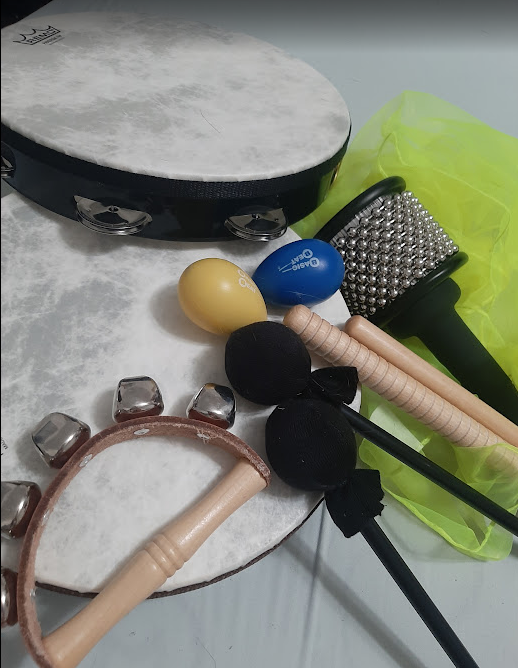
I was in my undergrad during covid which meant that when everything went online, so did our practicums. My first music therapy client as a student ended up being over telehealth. To accommodate this, clients received music therapy kits. The kits included a frame drum, a tambourine, rhythm sticks, egg shakers, a cabasa, jingle bells, and a scarf. Each practicum student had to purchase one too. This was the start of my music therapy collection. I haven’t added much since, besides a chromatic set of boomwhackers.
Researching Instruments
When you think of $500, it seems like a lot of money. At least, to me it does. It’s a shock though when looking at instruments to see that $500 doesn’t go as far as you would think. Not sure where to start, I looked up companies that sell instruments. The instruments that I had to purchase were through West Music, so I started there and then compared to other sellers.
The first thing I saw were drums. I love drums. Drums are fun, but drums are also expensive. I then had to ask myself, how often do I use drums in my sessions and when I do what drums do I predominately use. This became a good guide for me overall. i wrote out a list of the instruments, props, and materials I most commonly use in my sessions and started there. Like I said, $500 is a lot of money, that is, until you realize that a bundle of 24 sets of chiquitas costs $170. So what did I pick?
I made my list from what I use often. Across all my sessions and Listen and Learn classes that I teach, I commonly use chiquitas, rhythm sticks, scarves, jingle bells, and lollipop drums, so I found those first. I knew I wanted to have other items on my list so I chose bundles or a number that I felt was reasonable to the price. While I really like drums like djembes and gathering drums, they are expensive. I decided it was better to have an assortment than spend a lot on one drum. For my assortment, I picked instruments that we have at MTC that I like using, such as the resonator bells, rain stick, boomwhackers, and ocean drum. The animal castanets were too cute to pass up. While not a gathering drum, I thought the tubanito could be an affordable substitution. The parachute is a reliable prop which I would love to own. The total of the list was $499.38.
The Second Half Of The Assignment
The second half of the assignment was to find supplemental materials to our collection at MTC and Hope. That was a hard task. When looking at our inventory, both in person and the digital list, it feels like we have everything. We have drums of kinds, all types of shakers, every hand percussion you could think of, and pitched instruments too. There was not much that I could think of that we didn’t already have. I searched the few I could think of and scrolled through numerous websites to come across others.
Looking at the list, it might seem like the items are all over the place; and maybe they are. My first thought when thinking of what we don’t have, was adaptive mallets. I had access to adaptive mallets at WIU and ended up using them a lot with clients. I think this is a good thing to have available for future clients with mobility issues. The second was sensory floor tiles. I had seen them used in a classroom at Hope and thought they were cool. I thought about them again when discussing with Jess, a music therapist at MTC, about a client who repeatedly wanted to stand on top of the gathering drum. The third and last I thought of was an Easycussion. I had access to multiple at WIU. The way it is made makes it easy to set on a table or lap and play. It is also pentatonic which is great.
In my search I came across Mel-O-Dee Balls, tongue drums, and a canopy scarf. I saw the Mel-O-Dee Balls and thought they were interesting. They are played by squeezing them. This could be used to work on grasp, hand strength, and other fine motor skills. They are also color-coded the same as the resonator bells and boomwhackers we have. I have seen multiple clients use a steel tongue drum during sessions at MTC. I think having one that belongs to MTC rather than a client or therapist would be smart so more clients could have access. Lastly was the canopy scarf. We currently have one at MTC. I think it would be beneficial to have more than one.
Takeaway
My main takeaway besides the fact that instruments are expensive, is that I am so lucky that I have access to all the instruments I have at MTC and Hope. So much time and money has gone into me having the ability to use these instruments, props, and materials. I also am now more aware of everything we have in our inventory. I can branch out beyond shakers and rhythm sticks. One day, I hope to be able to grow my collection to be as plentiful.
I needed an album cover for all this talk of songwriting.
As a part of my internship assignments, I have written 8 songs. These 8 songs were a part of my midterm and are now used at one of the contracts I see, which is pretty wild, if I do say so myself. This week, my assignment was to write two more songs. One for myself and one that addressed mental health needs with teenage clients. This was very different from writing a song about winter or waiting our turn.
It’s scary to write something like this. When you write a movement song, the judgment you open yourself up to is musical in nature. When you write a song about emotions, you realize that you are opening yourself up for someone to judge what you think and feel. It is so important to remember this when asking our clients to partake in songwriting.
Songwriting
My Process
Looking back at my previous posts, I realized I have never talked about my songwriting or my process. The songs I have written, for the most part, have fallen into two categories: songs where I came up with the lyrics or basis for my lyrics first, and songs where I started with a chord progression or a melodic line. For these two songs I wrote, the mental health songs were part of the first category, whereas the song for myself started with the music first.
Writing The Mental Health Song
To create my lyrics, I started with a brain dump of emotions. Emotions that I have felt recently, mixed with thoughts and feelings I expressed in songs I wrote when I was a teenager. I then sorted through to create possible lyrics. Next, I went to my sister. I ran possible lyrics past her because I wanted her opinion, as she had also dealt with mental health struggles in our youth, and I wanted a different perspective from my own. I wanted to make sure the content was relatable. I was afraid of it being too heavy, and that’s when she gave me the greatest quote. She said, “GraceAnne, I was clinically depressed. What kind of music do you think I was listening to?” Don’t worry, I have her permission to say that. I just had to add music.
Whether starting with lyrics or not, I usually tinker around on my guitar to get the chord progression or melodic line. Messing around, I really felt drawn to a harmonic minor feel. I messed around and borrowed major chords from it’s parallel major, creating a mixed modal sound. This is just a fancy way to say the chord progression doesn’t really belong to major or minor, which fits a song about being stuck and trying to move forward.
Writing A Song For Myself
I found this to be harder than anything, not just for the reason I discussed in the beginning of this article, but because once I wrote it down and shared it, it made it true. True, that these feelings were mine. I could have written a song about anything, but without me trying formed into a song about struggling. A song about being angry and tired. A song about how exhausting it is to be a chronically ill and neurodivergent woman in this world. It’s scary to feel what may be considered as non-positive emotions and then to own those feelings.
Due to the weather, the guitar I have been using keeps going out of tune. Whenever I pick it up, the low E string has gone close to a full step flat. I didn’t realize the guitar was pretty much in Drop D tuning when I was noodling around melodically. Once I did notice, I tuned it so it was actually in Drop D and kept going. I had created a melodic ostinato that became the backbone of my song. It made it sound like a grungy, early 2000’s song, so I decided to add power chords, because nothing says grunge like power chords. For lyrics, I improvised them on the spot. I kept adding until I found ones that I liked.
How They Can Be Used
If I were to use either of my songs with a client, my first thought would be a song discussion and maybe even a rewrite afterwards. I like to think that what I wrote is something others can relate to. I remember being a teen, struggling with my mental health and wanting to have these conversations. Kids have complex emotions and it does not do them a service to pretend they don’t and censor anything we may perceive as being too heavy, especially if they have already expressed those feelings and thoughts.
Songwriting In Sessions
There are so many ways and reasons to use songwriting in sessions. You can do MadLib-style fill-in-the-blank to reinforce parts of speech. Fill-in-the-blank to work on turn-taking or making a song more adapted to the client. You can do a piggyback/rewrite where you write part of a song or a whole song to a familiar tune. You can even write a song from scratch. All these ways work on self-expression, choice making, and create space for silliness, problem-solving, and emotional processing.
Some Of My Favorite Songwriting I Have Done
Two of my favorites, which I have done during my internship, were MadLib-style fill-in-the-blank. I did it with my school contracts. We worked on parts of speech, turn-taking, impulse control, and self-expression by creating the silliest version of “All Star” by Smash Mouth. It was so different at each school. It’s so special to see them laugh and enjoy themselves while creating music.
Another favorite songwriting project I did was during a practicum at Western. I saw a group of adults with mental health goals. We rewrote “Make Your Own Kind Of Music” by Cass Elliot after discussing it. We then took turns listing what we each thought made the others special, as well as our favorite things about each other, and used that as our lyrics, as well as ways of coping when “nobody else sings along”.
Last Thoughts
Songwriting isn’t easy, but it is so rewarding to have that finished product. Songwriting is such a valuable tool to use in sessions, but also as a music therapist needing music that fits a specific need. I used to dread writing music, but there is something so nice about being able to create a song when I can’t find a song or a song doesn’t exist for the specific purpose I need it for.
I spent a lot of time combing through this Spotify playlist, along with others, in my search. Which songs are you familiar with?
A couple weeks ago my assignment was a rap challenge. To be honest, that was terrifying. I don’t know the first thing about rap. It’s not music that I have been exposed to a lot during my life. I mostly listen to ‘pop girlies’, indie, and musicals.
My assignment was to “create 3 rap based interventions to be used with clients across a variety of settings” and to “identify 5-10 appropriate rap songs that can be used with teens in the clinical setting.” Today, I’m writing about the interventions I came up with.
The first thing I did was go to my supervisors and get clarification. They weren’t expecting me to rap, right? The music I have been exposed to has used words I cannot, should not, and will not use. The idea of me trying to rap is one that would easily keep me up at night. Luckily for everyone in the world, they told me they use recorded music in sessions.
The second thing I did was get music recommendations from probably every person and source I could find and then sat down and really listened. I read through the lyrics of so many songs and while looking for music, had to face biases I didn’t realize I even had. Why don’t I listen to rap? Why do I feel the need to try and search for songs with deeper meaning? Do I do this with other genres of music when it comes to looking for music for session planning? What do I actually know about rap and it’s significance to culture? How do I deal with censorship? How much do I censor? Those are just some of those deep questions I had to ask myself.
Intervention One
Body Percussion- “Just Wanna Rock”- Lil Uzi Vert
For my first intervention, I picked “Just Wanna Rock” by Lil Uzi Vert. I really liked the beat and quickly got an idea from a session I was planning for one of my contracts at that time. What if I used this song for a body percussion intervention? When looking on YouTube to see if there were any play along body percussion videos for any rap songs, I found none. So let’s make one.
Instead of a play along video, I got the idea to print out little cards with the body percussion action on it. It would be like the play along video but tangible. I could mix and match them to create different patterns in real time. We do something similar with one of the classes we see at Hope, but instead of body percussion, the cards have different rhythms. The students then use the cards to create their own rhythm. What if I did the same thing but with body percussion. Students would work on sustained attention, following directions, respecting the choices of other’s, turn taking, and self expression.
I don’t currently have clients I would use this with, but it is something I would like to do in the future.
Intervention Two
Movement- “Shake It To The Max”- Moliy, Silent Addy, Skillibeng, Shenseea
The second intervention I created was movement to “Shake It To The Max” by Moliy, Silent Addy, Skillibeng, and Shenseea. For this movement intervention, I would have the clients create a dance together but having each client choose or create a dance move. I have done something similar at Sparc, but have never done it with a rap/hip hop song.
To do this, I would create a dance move pick list, a visual with different choices of dance moves. I would encourage group members to come up with their own moves or pick from the visual and then demonstrate/teach it to their peers. We would then chain these movement together with the music. Participants would work on gross motor, self expression, making choices, following directions, sequencing, social interaction, and respecting the choices of other’s. To further adapt, you could record it and make your own music video, if participants are willing.
Intervention Three
Song Discussion- “Wishing Well”- Juice WRLD
For the third intervention, I decided I wanted to do a song discussion. When looking through music, I came across “Wishing Well” by Juice WRLD and chose it. I have done song discussions while in school at WIU, including during one of my practicums, but never with rap music or younger clients. In listening to different songs, I saw that rap doesn’t shy away from topics we don’t like to talk about such as depression and drug use, this song included. I think sometimes we want to pretend that youth don’t deal with these issues. We all know that isn’t true.
In using this for a song discussion, I think it could be a bridge to talk about hard topics like depression, self worth, drug use, and the feeling of helplessness. On the flip side this song talks about a wishing well, opening dialogue for wishes we have had that haven’t come true and wishes we have for the future. Facilitating this, I would have clients circle/highlight words and phrases that stood out to them, ask about their thoughts overall on the song, and work through questions, letting them expand and direct the conversation, within reason. I would end the discussion by focusing on the symbolism of the wishing well in the song and ask about their wishes past, present, or future. Of course, this would go differently depending of the setting and the participation from clients.
I have not done a song discussion yet in my internship. I feel like when I do, I will realize that there’s a lot I need to learn and that it is different from my planning on an assignment.
Last Thoughts
I haven’t had the chance to use any of these interventions with my clients. That is not to say that I won’t in some compacity. It might be with a different song or used for another intervention. I could see myself using rap with one of the schools I see in Taylorville. I’m excited to keep learning and branching out into other genres of music I don’t have experience in.